

Haemorrhoids are often treated as a punchline or a minor inconvenience, but the physiological reality is far more complex. These are not merely "lumps"; they are vascular cushions within the anal canal that play a crucial role in continence. When they become swollen, inflamed, or displaced, the condition ceases to be just a nuisance—it becomes a medical issue that can dominate your physical and emotional landscape.
While many suffer in silence due to embarrassment, understanding the anatomy and the risks of delaying treatment is the only way to break the cycle of pain and anxiety.

What Actually Are Haemorrhoids?
Everyone has haemorrhoidal tissue. It is a cluster of blood vessels, connective tissue, and muscle that acts as a "bumper" to help control bowel movements.
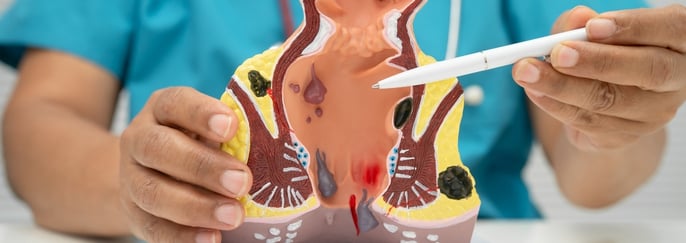
- Internal Haemorrhoids: Located inside the rectum. You usually cannot feel them, but they are prone to bleeding.
- External Haemorrhoids: Located under the skin around the anus. This area has many pain-sensing nerves, making them itchy and painful.
Who is susceptible?
While often associated with ageing, symptomatic haemorrhoids peak between the ages of 45 and 65. Men and women are affected equally, though pregnancy places women at distinct risk due to increased pelvic pressure.
In Hong Kong, we also observe cases in younger adults, often attributed to sedentary office lifestyles and dietary habits that contribute to straining.
The 4 Grades of Severity
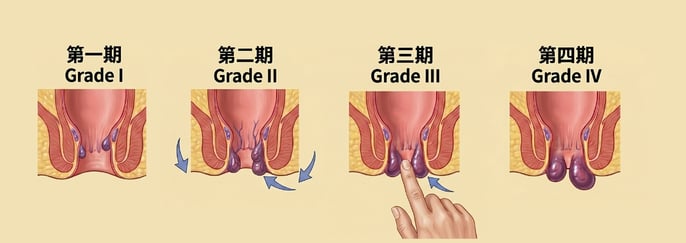
Doctors classify internal haemorrhoids into four grades. Understanding this progression is vital because Grade III and IV rarely resolve without intervention.
|
Grade |
Physical Description |
Symptoms |
|
Grade I |
Enlarged blood vessels that remain inside the anal canal |
Bright red blood on toilet paper; usually painless |
|
Grade II |
Tissue prolapses (slips out) during straining but retracts spontaneously |
Discomfort and bleeding |
|
Grade III |
Tissue prolapses during bowel movements or physical exertion and requires manual reduction (pushing back in) |
Pain, hygiene issues, and soilage |
|
Grade IV |
Tissue is permanently prolapsed and is irreducible (cannot be pushed back) |
Chronic pain, risk of thrombosis (clots), and significant impact on daily movement |
The Hidden Toll on Intimacy and Mental Health
Medical literature often glosses over this, but the impact of haemorrhoids extends deeply into the bedroom. It is not merely about "itching"; it is a mechanical and psychological barrier to intimacy.
- The "Mood Killer": The fear of sudden bleeding, odour due to mucus discharge (common in Grade III/IV), or the visibility of prolapsed tissue can create severe body image anxiety.
- Physical Pain: Sexual activity increases blood flow to the pelvic region, which can cause engorgement of haemorrhoidal tissue. For those with external or prolapsed haemorrhoids, friction or pressure near the area can be excruciating.
- Mental Exhaustion: Chronic pain drains serotonin. Patients often report irritability and "pain fatigue," where the constant background discomfort makes socialising or relaxing impossible.
Dangerous Myths and Home Remedies to Avoid
When desperate for relief, patients often turn to the internet or folklore. However, certain actions can turn a manageable condition into a surgical emergency.
1. Do NOT try to "pop" them
A haemorrhoid is not a pimple; it is a blood vessel. Attempting to puncture or "pop" a lump can lead to uncontrollable bleeding and severe infection (sepsis) due to the bacteria present in the area.
2. Avoid receptive anal intercourse during flare-ups
If you have active haemorrhoids, receptive anal intercourse can cause mechanical trauma, leading to fissures (tears in the lining) or rupture of the haemorrhoid. This increases the risk of infection and can turn a Grade II case into a thrombosed emergency.
3. Be wary of "miracle" creams and steroids
Over-the-counter steroid creams can offer temporary relief, but prolonged use without medical supervision (typically defined as more than one week) can cause skin atrophy (thinning of the skin). This weakens the anal lining, making it more prone to tearing and further injury.
4. Do not ignore "painless" bleeding
Never assume rectal bleeding is "just piles." Colorectal cancer and polyps share this exact symptom, and age is not a safety factor—younger patients can also be affected. Self-diagnosing and delaying a colonoscopy can be a life-threatening error.
- Anaemia: Chronic, slow blood loss from internal haemorrhoids can lead to iron-deficiency anaemia, causing fatigue and weakness.
- Strangulation: If the blood supply to a prolapsed haemorrhoid is cut off by the anal sphincter, it becomes "strangulated." This causes extreme pain and can lead to gangrene (tissue death).
- Thrombosis: A blood clot can form inside an external haemorrhoid, turning it into a hard, purple, and excruciatingly painful lump. In some cases, this requires urgent incision and drainage.

Modern Options for Surgical and Non-Surgical Care
Modern colorectal surgery prioritises organ preservation—fixing the problem without aggressive cutting whenever possible.
Non-Surgical & Minimally Invasive (Grades I-III)
- Medication:
- Venotonic drugs can strengthen blood vessel walls to reduce bleeding, but they do not "cure" the prolapse.
- THD (Transanal Haemorrhoidal Dearterialisation):
- A Doppler ultrasound locates the feeding arteries, which are then sutured to cut off blood flow. The tissue shrinks back to normal.
- Benefit: As there is no excision of tissue, post-operative pain is significantly reduced compared to traditional surgery.
- PPH (Stapled Haemorrhoidopexy):
- A circular stapler removes a ring of excess tissue above the haemorrhoids, lifting them back into position.
- Benefit: This procedure operates above the sensitive nerve endings of the anal canal, generally resulting in a faster recovery than excision.
Surgical Removal (Grade IV / Complex Cases)
- Haemorrhoidectomy: The complete removal of the haemorrhoidal tissue. While recovery is longer and involves more discomfort, it remains the gold standard for preventing recurrence in severe or complex cases.
Anaesthesia: Fear of pain during the procedure is unnecessary. Surgeries are performed under General Anaesthesia or Monitored Anaesthesia Care (MAC), ensuring you are asleep and comfortable.
Understanding the Risk of Recurrence
One of the most common concerns patients have is the risk of recurrence. The honest medical answer is: it depends on the procedure and your lifestyle.
Surgery acts as a "reset button," but it does not change the genetic or lifestyle factors that caused the haemorrhoids in the first place.
- Procedure efficacy: Traditional haemorrhoidectomy has the lowest recurrence rate but a longer recovery. Minimally invasive procedures (THD/PPH) have a slightly higher chance of recurrence over 5–10 years, but the trade-off is a significantly faster recovery.
- Lifestyle maintenance: If chronic constipation, straining on the toilet, or heavy lifting continues post-surgery, the remaining vascular tissue can swell again. Post-operative care—specifically maintaining a high-fibre diet and hydration—is the most effective way to ensure the problem stays resolved.
Navigating Public Wait Times and Private Coverage
- Public Sector (HA): In the public system, unless there is a complication like strangulation, haemorrhoid surgery is an "elective" procedure. Waiting times for a specialist appointment and subsequent surgery can span 1–2 years depending on the cluster.
- Private Sector: Private care allows for immediate scheduling, which is crucial for preventing Grade III haemorrhoids from progressing to Grade IV.
- Insurance & VHIS: Haemorrhoidectomy is a standard medical procedure. Many comprehensive insurance plans and VHIS (Voluntary Health Insurance Scheme) policies cover the costs. However, coverage varies by policy. It is strongly recommended to obtain pre-approval and check if your plan covers “day case” surgeries versus overnight stays.
Taking the Next Step Toward Recovery
Haemorrhoids are a progressive medical condition, not a character flaw. The risks of infection, thrombosis, and anaemia far outweigh the temporary embarrassment of a consultation.
If you are modifying your life—your diet, your movement, or your intimacy—to accommodate this pain, it is time to seek professional help. A simple examination can rule out more serious conditions and put you on a path to recovery.
Articles on this website are informative only and not intended to be a substitute for professional medical advice, diagnosis or treatment. They should not be relied upon for specific medical advice.
Source of reference:
- Centre for Health Protection (CHP). Haemorrhoid Flare-up – A No Laughing Matter. Non-Communicable Diseases (NCD) Watch, January 2011.
- Hong Kong Medical Journal (HKMJ). Consensus statements on diagnosis and management of chronic idiopathic constipation in adults in Hong Kong. Vol 25, No 2 (April 2019)
- Davis, B. R., et al. (2018). The American Society of Colon and Rectal Surgeons Clinical Practice Guidelines for the Management of Hemorrhoids. Diseases of the Colon & Rectum.
- Lohsiriwat, V. (2012). Hemorrhoids: From basic pathophysiology to clinical management. World Journal of Gastroenterology.
- National Institute for Health and Care Excellence (NICE). Haemorrhoidal artery ligation (IPG342).
- National Institute for Health and Care Excellence (NICE). Stapled haemorrhoidopexy for the treatment of haemorrhoids (IPG34).
- Hospital Authority. Waiting Time for Specialist Out-patient Services / Elective Surgery. Accessed on 9 February 2026.