
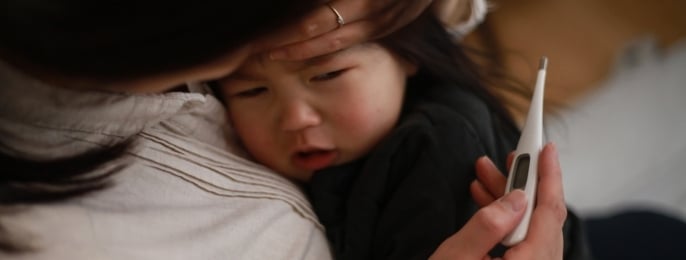
It is the scenario every parent dreads: it is 1am, and your child wakes up crying with a spiking fever, breathing difficulties, or a concerning injury. The panic sets in immediately.
With public hospitals in Hong Kong facing unprecedented demand and rising attendance fees, the "default" choice of rushing to a public Accident & Emergency (A&E) is not always the most efficient one.
However, parents often worry: "If I don't go to a major public hospital, will the facility be able to handle it if my child is seriously ill?"
Understanding the difference between Public Trauma Care and Private Hospital Acute Care is vital. It ensures your child receives the most appropriate treatment—whether that is a quick prescription, overnight observation, or intensive care—in the calmest environment possible.

What’s Happening to My Child? Symptoms to Watch For
The first step in deciding where to go is assessing your child's symptoms. While some situations clearly demand emergency attention, many common childhood illnesses and injuries can be effectively managed outside of the A&E.
The Landscape: Public A&E vs. Private Urgent Care
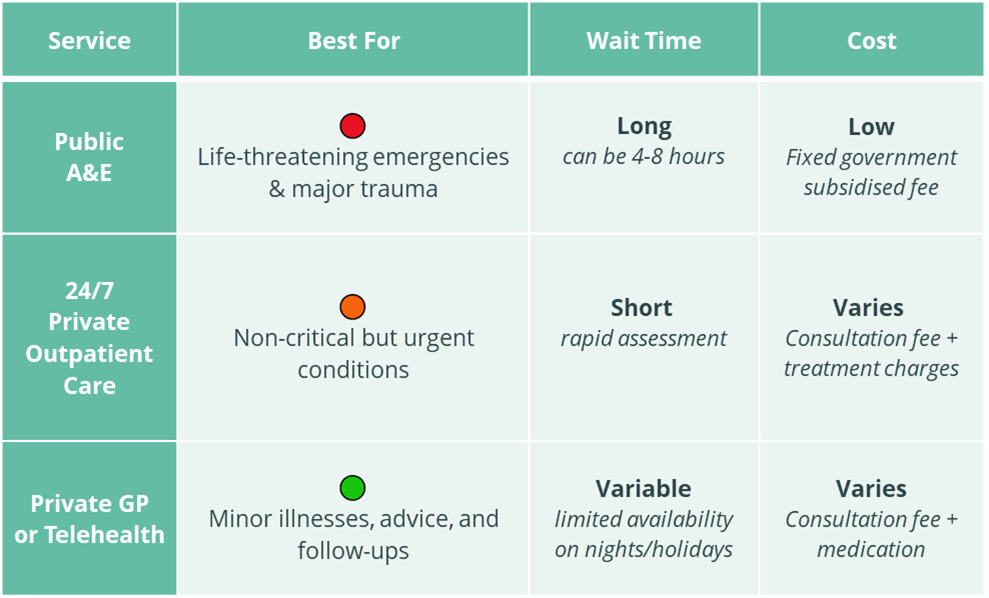
In Hong Kong, parents generally have three tiers of immediate care available. Knowing which one to choose can save hours of waiting.
- Public A&E (Trauma Centres): These are designed for catastrophic, life-threatening emergencies. They prioritise survival. If your child has a minor fracture or high fever, they are likely to be triaged as "semi-urgent" and may wait hours while critical cases are treated.
- Important Note: If you call a 999 ambulance, you will be taken exclusively to a Public Hospital A&E. You cannot request a private hospital drop-off.
- Private Hospital 24/7 Outpatient: This is more than just a "clinic." It is the intake point for a fully equipped hospital for acute illnesses and injuries that require immediate doctor attention, imaging, lab support, and direct admission if the condition is serious but not life-threatening.
- Telehealth / GP: Best for mild symptoms or advice when the child is stable.
The "Traffic Light" Symptom Guide
While every child is different, this system can help you triage the situation at home to decide the best destination.
🔴 RED: Go to Public A&E (Call 999 if necessary)
- Go here for immediate life-support.
- Unconsciousness: Child cannot be woken up.
- Major Trauma: High-impact car accidents, falls from significant heights.
- Severe Bleeding: Bleeding that cannot be controlled.
- Seizures: Fits that are continuing without stopping.
🟠 AMBER: Choose 24/7 Hospital Outpatient Care
- Go here for urgent medical attention, diagnostics, and potential admission.
- Breathing Difficulty: Look for effort rather than just sound. If your child is breathing hard—like they have just run a race—while they are resting, this is abnormal and requires immediate attention.
- Fevers (Specific Cases):
- Any fever in a baby under 3 months old.
- Fever in older children if they are lethargic, refusing fluids, or if the fever persists despite medication.
- Dehydration: Signs include dry lips, no tears, or fewer wet nappies.
- Injuries & Fractures: Broken bones requiring X-ray and casting, or deep cuts requiring stitches.
- Abdominal Pain: Suspected appendicitis or severe gastroenteritis.
🟢 GREEN: Monitor at Home / Telehealth
- Low-grade fever where the child is over 3 months old, drinking well, and still playing.
- Mild coughs or colds.
- Minor bumps or bruises.
Understanding Paediatric Triage
One of the main sources of anxiety at a public A&E is the "Triage Category." In the public system, a child with a high fever or a broken arm is often categorised as "Semi-Urgent" (Category IV). Because the staff must prioritise heart attacks and major trauma, "Semi-Urgent" patients often face wait times of 4 to 8 hours.
A full-service hospital offers a seamless pathway, eliminating the need for an ambulance transfer that is often required when a child's condition exceeds the capabilities of a standalone clinic:
- Triage & Stabilisation: Immediate assessment by the onsite doctor.
- Diagnostics: Rapid blood tests or imaging to confirm the diagnosis.
- Admission: If the condition requires it, the child is admitted directly to the Paediatric Ward or Intensive Care Unit for overnight monitoring and specialist treatment.
This continuity of care provides safety for the child and peace of mind for the parent.
Be Prepared: The "Go Bag"
It is natural to feel anxious when your child is sick. Preparation is a powerful tool for managing this stress. Have a small bag ready with essentials:
- Documents: Identification (HKID/Passport/Birth Cert) and Insurance details.
- Medical History: A list of your child’s medications, vaccination records, and allergies.
- Comfort: A phone charger and a favourite book or toy to keep your child occupied.
A Note on Parental Anxiety
Guidelines are helpful, but parental intuition is a powerful tool. You know your child best.
If something feels "off," or if the anxiety of monitoring them at home is becoming overwhelming, seeking professional care is the right decision. It is always better to seek medical advice than to leave any doubt for serious issues. Whether it is for reassurance or treatment, the priority is ensuring your child is safe, comfortable, and treated by experts.
Reviewed by
Dr. Euan SOO Tsung Liang
Dr. Helen LEE Pui Yan